

Species Origin Examination

Species Origin Examination
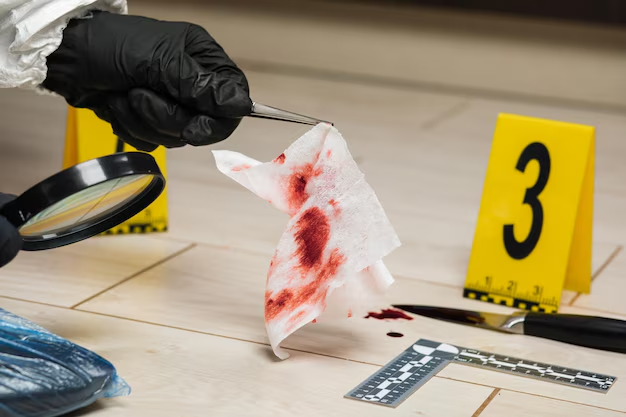
Species Origin Examination is a vital forensic process used to determine the biological source of blood, tissue, hair, or bone fragments recovered from a crime scene. In many criminal investigations, discovering biological material on a weapon, a vehicle, or a suspect's clothing raises an immediate and critical question: Is this material human? A suspect may claim that the blood on their hunting knife belongs to a deer they recently dressed, or that the hair on their bumper belongs to a stray dog. Forensic species origin testing scientifically validates or refutes these claims, directing the focus of the investigation efficiently and definitively.
The differentiation between human and non-human biological evidence relies on advanced immunological, biochemical, and genetic techniques. Proteins and DNA structures vary significantly across different species. By exploiting these biological differences—such as species-specific antigens in the blood or distinct mitochondrial DNA sequences—forensic scientists can confidently identify the source animal. This testing is not only critical in homicide and assault investigations but also plays a central role in wildlife forensics, aiding in the prosecution of illegal poaching, animal cruelty, and the illicit trade of endangered species products.
Aspire Forensics is a leading provider of Species Origin Examination in Noida. We assist law enforcement, environmental agencies, and private legal practices in analyzing questionable biological materials. Our laboratory protocols ensure that even minute, degraded, or mixed samples are processed with the highest degree of accuracy, providing clear, undeniable proof of origin.
Clients utilizing the best species identification services in Noida depend on our multidisciplinary approach. We do not rely on a single test; rather, we utilize a combination of morphological screening, immunological precipitation, and DNA-based assays to guarantee the reliability of our findings.
For complex legal and environmental cases requiring top species origin examination services in Greater Noida, our certified experts deliver comprehensive reports that translate complex biological data into clear, court-admissible evidence, ensuring that the facts of the case are scientifically supported.
Scientific Principles of Species Identification
Identifying the species origin of a sample relies on the fundamental principles of immunology and genetics. When a foreign biological substance (an antigen) enters an animal's body, its immune system produces specific antibodies designed to bind exclusively to that antigen. Forensic science utilizes this natural lock-and-key mechanism to identify unknown blood and tissue samples.
Immunological Testing: The most common method for species identification of bloodstains involves precipitin tests, such as the Ouchterlony double diffusion test or modern immunochromatographic assays. In these tests, an extract of the questioned bloodstain is introduced to antiserum—a serum containing antibodies specific to a certain species (e.g., anti-human serum, anti-canine serum). If the blood is human, the anti-human antibodies will bind to the human antigens, creating a visible precipitate (a cloudy line or band). If the blood belongs to a pig, no reaction will occur with the anti-human serum. These tests are incredibly sensitive and can detect human proteins even in bloodstains that have been dried for years.
Genetic Testing (DNA): When immunological tests are inconclusive due to severe degradation or when a precise species identification (beyond just "non-human") is required, genetic testing is employed. Scientists sequence specific regions of the mitochondrial DNA, such as the cytochrome b gene. Because this gene mutates at a known rate, its sequence acts as a genetic barcode. By comparing the extracted DNA sequence against a global database (like GenBank), the exact species—whether it is a domestic cat, a Bengal tiger, or a human—can be definitively identified.
Methodology and Analytical Process
The examination process begins with a careful morphological assessment of the evidence. If the evidence is hair or bone, the initial step is often microscopic. Human hair has distinctly different cuticular scale patterns and medullary indices compared to animal hair. Similarly, human bone exhibits a different osteon structural arrangement (Haversian systems) than the bone of most mammals. This microscopic triage determines the direction of the subsequent biochemical tests.
For suspected blood or tissue, a small cutting or swabbing of the stain is taken. The sample is suspended in a saline solution to extract the proteins. This extract is then subjected to a rapid immunochromatographic test (similar in mechanics to a pregnancy test) specifically calibrated to detect human glycophorin A or human hemoglobin. A positive result immediately confirms the presence of human blood, allowing the sample to proceed to individualized DNA profiling.
If the test is negative for human proteins, the investigation shifts to determining the exact animal species. The extract may be tested against a panel of antisera (bovine, equine, canine, feline, avian). In wildlife crime scenarios—such as suspected illegal ivory trading, bushmeat smuggling, or illegal hunting—the sample is forwarded for mitochondrial DNA sequencing to provide undeniable taxonomic identification.
Key Areas of Species Analysis
Blood & Tissue Assays
Utilizing antibody-antigen precipitin tests to rapidly distinguish human blood from domestic or wild animal bloodstains.
Hair Morphology
Microscopic evaluation of the cuticle and medulla to differentiate human trace hair evidence samples from pet hair or fur.
Wildlife Forensics
Applying mitochondrial DNA sequencing to identify endangered species in cases of illegal poaching and animal trafficking.
Significance in Criminal and Environmental Law
Species origin testing serves as an immediate filtering mechanism in violent crime investigations. It is not uncommon for a suspect in a homicide case to excuse a bloodstain on their clothing or vehicle by claiming they recently hit an animal or were preparing raw meat. By quickly establishing that the blood is unequivocally human, investigators can confidently proceed with interrogations and seek warrants for further DNA analysis.
In the realm of environmental and wildlife law, species origin examination is the primary tool for prosecution. The illegal trade of endangered species relies heavily on disguising the product—selling tiger bone as cattle bone, or rare bird feathers as common poultry. By genetically sequencing these biological remnants, forensic scientists provide the hard evidence required by customs and border protection agencies to enforce international conservation treaties like CITES (Convention on International Trade in Endangered Species).
Furthermore, in cases of animal cruelty, identifying the species of blood on a weapon or the origin of tissue found at a suspected dog-fighting ring is crucial for building a solid legal case against the perpetrators. The ability to definitively prove the origin of biological matter ensures that both human and non-human victims receive justice.
Limitations of Species Testing
While highly accurate, species origin testing has inherent scientific limitations. Immunological tests rely on the structural integrity of proteins. If a bloodstain has been exposed to extreme heat, harsh chemical bleaches, or severe bacterial putrefaction, the proteins may denature. Denatured proteins will no longer bind to the antibodies in the antiserum, potentially resulting in a false negative.
Additionally, closely related species can sometimes exhibit cross-reactivity in older immunological tests. For example, antiserum designed for humans might slightly cross-react with the blood of higher primates like chimpanzees. However, modern forensic assays and DNA sequencing have largely mitigated this issue, providing highly specific and targeted identification. Our laboratory ensures that all environmental factors and potential cross-reactions are accounted for before finalizing a report.
Frequently Asked Questions
-
1. How do you prove blood on a knife is not animal blood?
We use specific immunological assays that react exclusively to human hemoglobin. If the blood on the knife is from an animal, the test will yield a negative result, and we can then use animal-specific antisera or DNA testing to identify the exact animal.
-
2. Can you identify the species of a single strand of hair?
Yes. By examining the microscopic structure—specifically the cuticular scale pattern and the width and shape of the medulla—we can differentiate human hair from animal hair. For exact animal species, further DNA testing of the hair shaft may be required.
-
3. What happens if the sample is very old or degraded?
If the proteins have degraded to the point where immunological tests fail, we turn to mitochondrial DNA (mtDNA) sequencing. Mitochondrial DNA is highly robust and can often be recovered from ancient or severely degraded bone and tissue samples.
-
4. Is species origin testing used for food fraud?
Absolutely. Species origin testing is routinely used to investigate food adulteration, such as verifying if meat sold as "beef" actually contains horse meat, or if expensive caviar is genuinely from sturgeon.
